Karl Grosh: Research Projects
Cochlear mechanics
Understanding the mechanics of normal hearing is central to building prothesis and noninvasive diagnostic tools. Our overarching goal in this project is to build a virtual laboratory for simulating the response of the cochlea. Such a capability will enable the prediction of the effects of different types of damage, efferent stimulation and the effects of electrical stimulation on the cochlea. In this project, hybrid numerical techniques are used to model the acoustic repsonse of the fluid-loaded basilar membrane and attached structures (including the outer hair cell-Deiter cell-tectorial membrane system). Through this computational framework, models for the linear, nonlinear and active mechanics of the organ of corti have been developed, tested and compared with experimental data from in vivo test data performed close collaboration with Dr. Fred Nuttall from Oregon Health Sciences University, Dr. Dave Dolan and Kresge Hearing Research Institute. Typcially one graduate student and one post-doc. Alumni are Drs. Anand Parthasarathi, Sripriya Ramamoorthy, and Niranjan Deo. Post-docs have been Dr. Ed Givelberg and Dr. Xiaoai Jiang. Current graduate students on the project are Julien Meaud and Yizeng Li.
- Modeling
S. Ramamoorthy, N. V. Deo, and K. Grosh.
A mechano-electro-acoustical model for the cochlea: Response to acoustic stimuli.
J. Acoust. Soc. Amer., 121(5), pp. 2758-2773, (2007).
A.
A. Spector, N. Deo, K. Grosh, J. Tilak Ratnanather, R. M. Raphael. Electromechanical models of the outer
hair cell composite membrane. J.
Membrane Biology, 209
(2-3), pp 135-152 (2006).
N. Deo and K. Grosh, A modified area
motor model for outer hair cell mechanics. Biophys. J., 86(6), 2004. Nonlinear constitutive model for outer hair
cell forward and reverse electromecahnical transduction based on a two-state
Boltzman including a state dependent stiffness.
Anand A. Parthasarathi , Karl Grosh and
Alfred L. Nuttall.
Three--dimensional numerical modeling for global cochlear dynamics. J.
Acoust. Soc. Amer., 107(1), Jan. 2000, pp. 474-485 (2000).
- Physiological Experimentation
K.
Halsey, K. Fegelman, K. Grosh, and D. F. Dolan. Long term effects of acoustic trauma on the
electrically evoked otoacoustic emission. J. Assoc. for Res. in
Otolaryngology, 6(4), pp
324-340, (2005).
K. Grosh, J. Zheng, E. deBoer, A. L.
Nuttall. High frequency electromotility of the cochlea. J. Acoust. Soc. of Amer, 115, 2178-2184,
(2004).
Anand A. Parthasarathi, Karl Grosh,
Alfred L. Nuttall, and Jiefu Zheng.
Influence of direct current stimulation on the in vivo basilar membrane velocity response. J.
Acoust. Soc. Amer., 113,
pp. 442-452, (2003).
Alfred L. Nuttall, Tianying Ren, Egbert
de Boer, Jiefu Zheng, Anand Parthasarathi, Karl Grosh, Menghe Guo, and David Dolan. In vivo micromechanical measurements of the
organ of Corti in the basal cochlear turn. Audiology and Neuro-otology 7 (1) pp. 21-26, (2002)
L. Nuttall, Grosh, K., Zheng, J., de
Boer, E., Ren, T., Zhao, Y., Spontaneous basilar membrane oscillation and otoacoustic emission at 15 kHz in a guinea pig. To appear J. Assoc. Res.
Otolaryngology 2004.
A guinea pig exhibited a 15 kHz spontaneous otoacoustic emission that I could
hear (!) - analysis and discussion of relevance.
Cochlear
Analog Electroacoustic Transducers
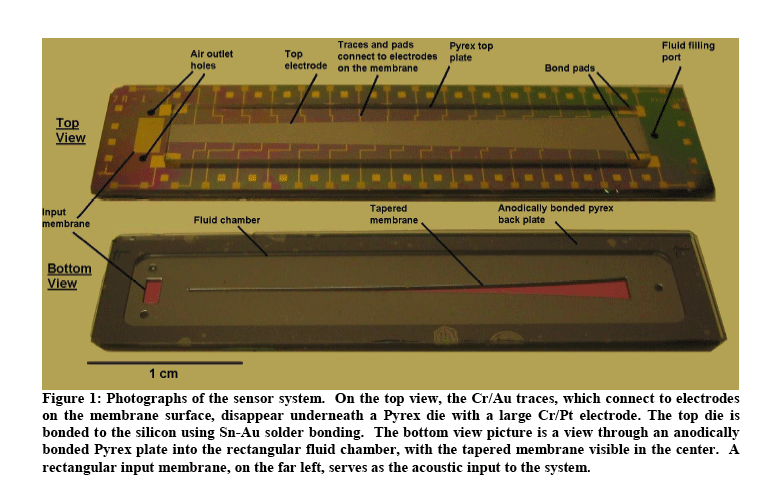
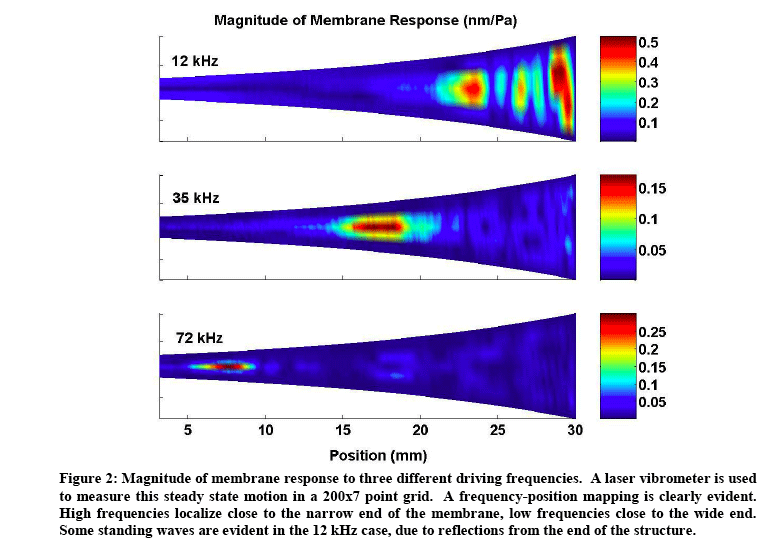
Here we try to co-opt the design of the cochlea for the purposes of designing better microphones and hydrophones. Currently we have two emphases (1) to build a micromachined cochlea with multi-channel output (2) optimize the output of a single-channel transducer consisting of a fluid coupled device. Robert D. White, Lei Cheng and Robert Littrell are graduate students working on the project.
R. D. White and K. Grosh,
Microengineered hydrodynamical cochlear model. Proc. of the National Acad. of Sci., 102 (5), pp 1296-1301 (2005).
See Rob White's wepage for a compilation of papers and presentations for micromachined electroacoustic transducers . Funding for this project has come from ONR, NSF and The University of Michigan. The National Science Foundation ran a nice piece on this work and it implications, click here to view. Further, there were a few other webstories written regarding the PNAS paper - please see the PhysicsWeb article and group picture and the MSNBC article as examples.
Growth
of Biological Tissue
With
Professors Ellen Arruda and Krishna Garikipati, we have developed a framework
for studying the growth of biological tissue using computational and in
vitro biological models.
We are collaborating with clinicians to implant the in vitro constructs and develop controlled in
vivo models of growth.
The hallmark of our work is the careful control and study of the influence of
mechanical loading and the chemical environment on growth. The tissue
engineering work of graduate student Sarah Calve (in collaboration with us and
Prof. Robert Dennis now at North Carolina State University) is central to the
efforts along with the computational efforts of Harish Naraynan. Joe Olberding and
Devin O'Connor are the current graduate students on the project.
J.
E. Olberding, H. Narayanan, E. M. Arruda, K. Grosh, S. Calve. Biological Remodelling: Stationary
Energy, configuration change, internal variables and dissipation. J. Mechs.
and Physics of Solids, 54 (7), pp 1493-1515, (2006).
K. Garikipati, Arruda, E. M., Grosh, K.,
Narayanan, H., Calve, S., A continuum treatment of growth in biological tissue:
The coupling of mass transport and growth. J. Mechs. Phys. of Solids, 52(7), pp 1595-1625, (2004).
S.
Calve, R. G. Dennis, P. E. Kosnik II, K. Baar, K. Grosh, and E. M. Arruda. Engineering of functional tendon. Tissue Engineering 10
(5-6), pp 755-761 (2004).
Next listed is Jeff Bischoff's work on
soft tissue constitutive modeling done with Ellen and me. The idea here was to
develop micromechanically motivated constitutive laws for soft biological
tissues with as few parameters as possible.
J. E. Bischoff, E. M. Arruda, K. Grosh. A rheological network formulation for orthotropic
viscoelasticity in soft tissue. Biomechanics
and Modeling in Mechanobiology, 3(1),
pp. 56-65 (2004).
J.
E. Bischoff, E. M. Arruda, and K.
Grosh. A microstructurally based orthotropic hyperelastic constitutive law. ASME
J. Appl. Mech., 69 (5),
pp. 570-579, (2002).
J.
E. Bischoff, E. M. Arruda, and K.
Grosh. Finite element simulations of orthotropic hyperelasticity. Finite
Element Analysis and Design, 38 (10), pp. 983-998, (2002)
J.
E. Bischoff, E. M. Arruda, and K.
Grosh. Orthotropic hyperelasticity
in terms of an arbitrary molecular model.
ASME J. Appl. Mech., 69 (2),
pp. 198-201, (2002).
J.
E. Bischoff, E. M. Arruda, and K.
Grosh. A new constitutive model
for the compressibility of elastomers at finite deformations. J. Rubber
Chem. and Tec, 74 (4), pp. 541-559, (2001).
J.
E. Bischoff, E. M. Arruda, and K.
Grosh. Nonlinear constitutive
models for skin response. J. Biomech. 33,
pp. 645-652, (2000).
J.
E. Bischoff, E. M. Arruda, and K. Grosh,
A rheological network
formulation for orthotropic viscoelasticity in soft tissue. Biomechanics and Modeling in
Mechanobiology,
to appear.
Completed Research Projects
These projects represent areas of
interest and previous work that are not currently active.
Design of Ultrasonic Phased Arrays for
Noninvasive Therapy
The objective of this project was to develop
and apply state of the art finite element tools for
modeling the response of an ultrasonic phased array of piezoelectric
transducers in contact with the human body. Novel finite element techniques and
parallel computer algorithms are used to speed computations. In particular, the
predictive capability is applied to (i) the design of arrays for high intensity
focused ultrasound (HIFU) for tissue ablation (ii) the evaluation of treatment
strategies for HIFU for cardiac and cancer therapy. We interacted with array designers
for experimental comparisons and with U of M Medical school personnel for
applications and tissue modeling.
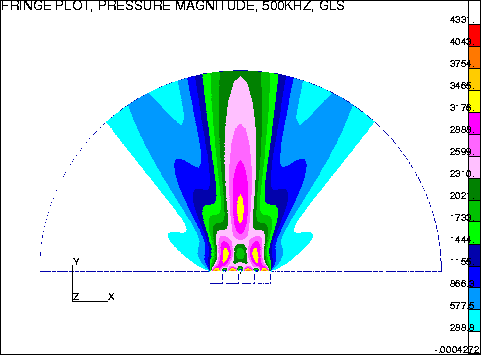
Pictured:
Pressure field from simple four element piezoelectric array at 0.5 MHz; yellow
areas show focus regions.
Results and papers
Two graduate students graduated with PhDs
(Yuan Lin and John Dodson) with roughly 4 years of funding (from the Whitaker
Foundation and ONR).
Yuan
Lin and K. Grosh. Iterative
solution strategies for three-dimensional high frequency response of
fluid-loaded piezoelectric transducers. Finite Element Analysis and Design 39 (10): 951-964,
(2003). We show the
effectiveness of various iterative solvers for the coupled piezoelectric
elastic and fluid coupling problem. We find that SSOR with a QMR algorithm
works well with good memory to iteration count trade-off. Saad's ILU techniques
also work well, with higher memory requirements. Convergence is an issue as the
problem size increases and with added losses (mostly acoustic in this case).
Yuan
Lin and Karl Grosh. Topology
optimization of the kerf filling in ultrasonic phased arrays. J. Acoust. Soc. Amer., 112
(5) pp 1968-1979, (2002).
Yuan
Lin and K. Grosh. Design of ultrasonic array elements for acoustic power
considerations. IEEE Transactions on Ultrasonics,
Ferroelectrics and Frequency Control. 2002. 49 (1)
pp. 20-28 (2002).
DYNAMICS OF FLUID-LOADED STRUCTURES
Wave-vector filtering algorithms
Development of Prony based parameter
estimation techniques for extracting the complex wave-vector nature of the
response of structures (beams, plates and shells, with and without fluid
loading). This work started with Earl Williams while I was at NRL. Pete
Halliday extended the idea by using maximum likelihood methods, which are more
powerful, robust and flexible to the problem in his elegant paper. These
techniques will be of use not only for spectral and parameter estimation, but also
for intensity/powerflow analysis.
Karl
Grosh and Earl G. Williams.
Complex wave--number decomposition of structural vibrations. Journal
of the Acoustical Society of America, 93(2),
pp.836-848, (1993).
Pete
Halliday and K. Grosh. Maximum
likelihood estimation of structural wave components from noisy data. J.
Acoust. Soc. Amer. 111 (4), pp. 1709-1717 (2002).
Modeling intersections and joints
Real structures involve the intersection of
members at joints (e.g., welds or rivets). Methods are developed for
consistently coupling elasto-dynamic theory (necessary to describe the complex
geometry of the joint) with reduced theories (beams, plates or shells, which
are adequate away from the inhomogeneity). Using these methods, one may study
the effect of joint geometry and develop reduced order models for complex
joints.
Pete Halliday and K. Grosh. Dynamic response of complex structural
intersections using hybrid methods.
ASME J. Applied Mech. 66(3),
pp 653-659, (1999).
Finite element method development
Mid and high frequency structural
acoustics problems pose a significant challenge to existing computational
algorithms and hardware. In this work, Galerkin generalized least squares (GGLS)
methods are developed to reduce the real costs of computatation (memory and
compute time). GGLS methods enable the inclusion of analytic information about
the wave-nature of the structural system into the discrete, finite element
setting. For coupled, two-dimensional problems, more than an order of magnitude
improvement has been achieved in memory and computational time. This work was
largely done at Stanford with Peter Pinsky.
Karl
Grosh. Residual based methods for
fluid-loaded beams. Computer Methods in Applied Mechanics and Engineering, 190,
pp. 2543-2554, (2001).
Karl Grosh and Peter M. Pinsky. Galerkin generalized least squares
finite element methods for time
harmonic structural acoustics. Computer Methods in Applied Mechanics and
Engineering, 154 (3-4),
pp. 299-318, (1998).
Isaac
Harari, Karl Grosh, Thomas J. R. Hughes, Manish Malhotra, Peter M. Pinsky,
Lonny L. Thompson. Recent
developments in finite element methods for structural acoustics. Archives of Computational Methods in
Engineering,
3 (2-3), pp.131-309, (1996).
Karl
Grosh and Peter M. Pinsky.
Galerkin generalized least squares methods for Timoshenko beams. Computer
Methods in Applied Mechanics and Engineering, 132,
pp.1-16, (1996).
Karl
Grosh and Peter M. Pinsky. Complex
wave--number dispersion analysis
of Galerkin and Galerkin least squares methods for fluid-loaded plates. Computer
Methods in Applied Mechanics and Engineering, 113,
pp. 67-98, (1994). How to do dispersion analysis for finite element
approximations for coupled systems. Specific results for the accuracy of finite
element interpolations of fluid loaded plates. The error estimates provided by
dispersion analysis give real guidlelines for discretization of coupled
problems.
Smart structures
Design of efficient horn speaker systems
by via curvature changes to PVDF, piezo-active film. Model predictions using
Abaqus and Comet acoustics are used to drive the design; comparisons to experimental
measurements of prototypes. With Prof. Diann Brei (MEAM).
Kelly
Bailo, Diann Brei and Karl Grosh. Investigation of piezoelectric polymeric
active diaphragms for sound sources. ASME J. Vib. Acoust., 125 (2): 145-154, (2003).
NONLINEAR DYNAMICS, VIBRATIONS AND NOISE
Contact and rattle generated noise and
vibration
Contact and rattle noise have become an important
area for automotive applications. These noise sources are generated by the
impact of two structural components. Vibration and noise levels are a function
of two nonlinear processes: contact and multibody dynamics. Numerical and
analytic models have been developed to predict the motion and acoustic
response. With Dr. Zheng-Dong Ma (MEAM) and Karen Fegeleman's PhD research
(about 3 years of industry funding).
Karen.
J. L. Fegelman and K. Grosh.
Dynamics of a flexible beam contacting a linear spring: experiment and
analysis. ASME J. Vib. Acoust. 124 (2), pp. 237-249 (2002).
Gear noise
The linear and nonlinear equations of
motion of interacting gear sets are developed. Linearized stability analysis
and nonlinear direct computations are performed. With Prof. Jim Barber (MEAM),
Sejoong Oh's PhD research.
Sejoong Oh, Karl Grosh and J. R.
Barber. Energy conserving
equations for gear systems. ASME J. Vib. Acous. to appear, 2004.
James
R. Barber, Karl Grosh and Sejoong Oh,
Energy considerations in systems with varying stiffness. ASME, J. Appl. Mech., 70
(4), pp. 465-469, (2003).
Silencing and Noise Control in Ducts
(mufflers and hydraulic silencers)
Sripriya
Ramamoorthy, K. Grosh, and Tony Nawar.
Structural acoustic silencers-Design and experiment. J. Acoust. Soc. Amer., 114
(5), pp. 2812-2824, (2003).
Sripriya
Ramamoorthy, Karl Grosh, John M. Dodson.
A theoretical study of structural acoustic silencers for hydraulic
systems. J. Acoust. Soc. Amer., 111
(5), pp.
2097-2108, (2002).
John M. Dodson, David R. Dowling and
Karl Grosh. Design and effectiveness of in-line tuning cables for quieting
hydraulic power units. J. of Noise Control Engineering 46
(1), pp. 15-22, (1998).